The Veil War

"and then I was like, 'Holy crap, goblins!'"

The Really Big Idea: Tim Miller

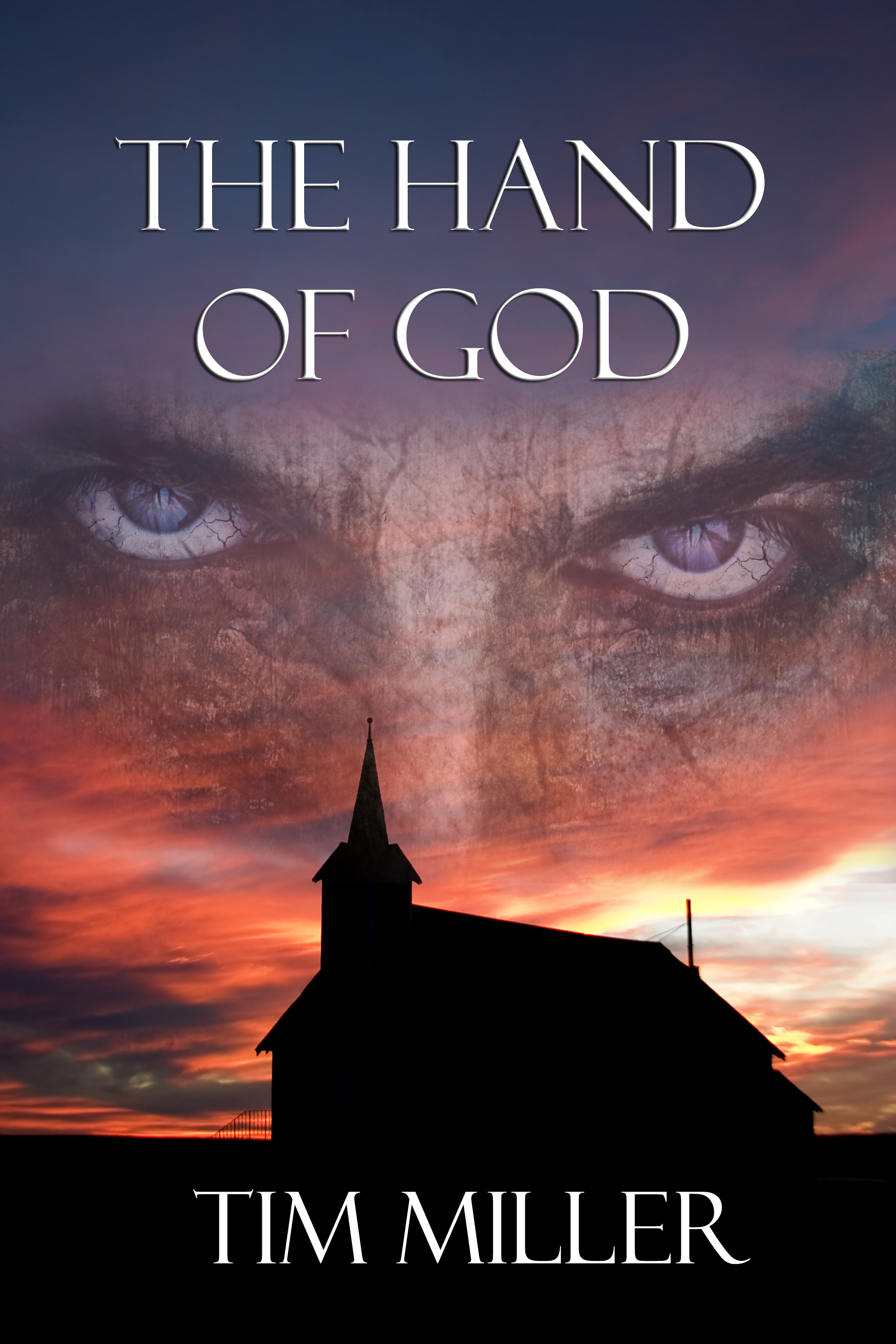
I ran into Tim Miller on the Twitter, and saw that he was a writer. Sweet, I thought. Then I saw that his book was titled, “The Hand of God.” Sweeter. Johnny Cash’s God’s Gonna Cut You Down started playing in my head. I looked closer, and saw that there could be no song more appropriate to the matter of the book. Check it out.

PS., I am such an asshole to have this sitting in my drafts folder for so long without publishing it. My apologies to Tim, you the dear reader, all the small gods of propriety and the universe at large.

The Birth of the Hand of God

The idea for this story came from a combination of a several things.  I was at a time in my life, almost exactly one year ago, when things were going incredibly bad for me.  I had just had a business fail, we’d lost our house, cars and had to move across the country to find work.  Shortly after that our marriage totally fell apart and we’d separated.  During that mess, my ex decided to take our daughter and move to another state with her without telling me or allowing me to see her (that’s all been worked out now), so needless to say, I was in a very bad place at the time.  I was broke, lonely and quite angry.
During this time, I had begun watching Dexter.  Everyone knows who Dexter is, for those who don’t, he’s the serial killer who works by day as a forensic analyst for the Miami police department.  Well, I found the show highly intriguing and it made me think.  As I was thinking, I reflected on my up until now, useless college degree in Bible and religious studies.  I remembered when I was involved in ministry how many people in churches and even preachers would do bizarre, and often horrible things to others and say it was because God told them to.  They felt “led”, “guided” or “convicted” by the holy spirit to do whatever crazy off the wall thing it was, which in their minds got them off the hook.

So with those ideas, Pastor Charlie was born.  I thought, what if there was a preacher who thought God was telling him to kill sinners in a brutal and ritualistic way?  So I began writing it, but not from a cop or someone’s point of view trying to stop him, but from Charlie’s own point of view.  I thought it would be fun to take the reader inside of his twisted mind and see how he justifies what he does.  Things get more interesting in the book, when another preacher comes along with a few of his own tricks up his sleeve and the story continues to evolve from there.

Some of the biggest issues I had in the book was how grounded did I want the book to be in reality.  Did I want it to be totally realistic?  Or did I want to put a supernatural twist on it?  I struggled with this off and on a lot, but in the end supernatural won.  I figured you can’t have a book dealing with religion from such an angle without some supernatural activity.  I think in the end it made the book much more interesting and raised the stakes considerably. There is an underlying message all throughout the book that things are never what they seem, or what we might expect them to be.

The Hand of God was a lot of fun to write.  I’m currently working on a second book in the Pastor Charlie series.  The biggest challenge with any of these stories is getting him into these jams, and then figuring out how I’m going to get him out.  Especially with as powerful his enemies are.  Either way, I hope everyone enjoys reading it and maybe even learn a few things as well. I learned a lot while writing it.  Thank you to Stephen for having me here.  Feel free to contact me!

Buy The Hand of God: amazon

Visit the author’s website | follow him on twitter

Chapter 16

I really don’t want this to turn into Veil War Fridays. But that seems to be the way of things, lately. My apologies for the untimely posting, but between work and a sudden, uncontrollable desire to rearrange a lot of the stuff that has happened in the last couple chapters (and indeed, the next couple as well) things have taken more time than I had hoped.

So, excuses out of the way, here at long last is Chapter Sixteen.

“Your sword is a prize of battle, won from the goblins. Prince Raimond and the Strategos both realized at once that it did not have the look of the goblin-work.”

“I noticed that myself, but I didn’t think much of it. My knowledge of goblins being so extensive.”

Father Pietr smiled. “Yes. There are goblins on many worlds; even goblins from the same world have different customs, different ways of sword-making. Could it not be from some tribe we know nothing of? But there is this: your sword looks like something out of our own history. A sword, much like yours, rests in the royal armory. It was taken from the dead hand of a goblin king by King Henric II six hundred years and more ago.”

I have a question for my readers. I have throughout this whole story kept the writing as spare as I could. No florid descriptions – just sketches of description and characterization (brief, but hopefully evocative) and focusing most of the effort on dialog and descriptions of the action. I’d like your opinion on how that is working.

And as always, please point out in the comments any grammatical or other errors. While I try to make it as clean as I can before posting, I don’t have a professional editor on staff, more’s the pity. Thanks for your patience as I try to push this out the door as fast as I can.

Update

Kids, I just wanted everyone to know that Chapter 16 is inbound, scheduled for arrival for tomorrow. I would have posted today – even early this morning – had I not had a modest moment of inspiration that led me to rearrange and edit what I had prepared for you.

It’s funny, but I now have a little Ian Healy who sits in my head and keeps asking, “Does this advance the story?” I have no earthly idea what the real Ian Healy sounds like, but I can tell you that the one in my head is whiny and annoying. Sometimes he has a bit of a lisp, and his voice is a bit twee and high pitched. However, he is nearly always right, the bastard.

And after I post Chapter 16, I finish work and head for the hills to shoot at lots of defenseless water bottles, paper targets and other innocent, inanimate objects. There will likely be a fair amount of alcohol consumption and bacon eating. Note well, I will make every effort to pursue these activities consecutively, not concurrently. Which reminds me, a few weeks back I attended (as an observer) a training class run by F2S Consulting on the proper use of carbines. I have witnessed an epic amount of bad training in my life. A fair bit of mediocre training. The occasional good instruction. I can count on the fingers of no hands the number of times that I’ve seen as good a trainer as Jack from F2S. I admit that I know next to nothing about the use of weaponry in combat by way of personal experience. But there is a smell to competence, and Jack smells like heaven.

If you are ever interested in learning to shoot, to shoot better – F2S is the place to go. Jack taught some of the best in the world to shoot better, I’m sure he can help you. You can find his webpage here; and I can assure you that as soon as I can pry loose the cash, I will be taking his classes.

The Really Big Idea: M. H. Mead

I think I first ran across the idea of genetically engineered dogs in Starship Troopers. Granted, it wasn’t a major part of the story, but it got me thinking. Reading the Uplift Series by David Brin, I wished he had seen fit to have included uplifted dogs along with the dolphins, chimps and gorillas. I’ve always been a dog kinda guy. This quote is again apropos:

There was one species on Terra that lived in very close symbiosis with the domesticated primates. This was a variety of domesticated canines called dogs.

The dogs had learned to achieve a rough simulation of guilt and remorse and worry and other domesticated primate characteristics.

The domesticated primates had learned how to achieve simulations of loyalty and dignity and cheerfulness and other canine characteristics.

The primates claimed that they loved the dogs as much as the dogs loved them. Still, the primates kept the best food for themselves. The dogs noticed this, you can be sure, but they loved the primates so much that they forgave them.

There’s a lot to be said about dogs. Really, really smart dogs would allow rather more scope. And that’s what Margaret Yang and Harry Campion are attempting.

The Big Idea—Margaret Yang and Harry R. Campion writing together as M.H. Mead

There are many things to consider when two people collaborate on a novel, but here’s a biggie—do we both love the story? Are we both willing to take this emotional journey with our characters? THE CALINE CONSPIRACY is about dogs, and neither of us has owned a dog in years. Could we let our personal history color our fiction, relive the pain of losing our pets, face the guilt we feel over their deaths?

Some dogs are easy to love. Ours weren’t. Take Hobbes, a goofy-looking mutt that Margaret adopted from the pound. For eight years, Hobbes was the only child Margaret had. She kept Margaret company when her husband was out of town and took daily walks with her. While Hobbes wasn’t affectionate, she was at least quiet and well-behaved.

That is, until Margaret’s children were born. Hobbes never got over losing her status. Once human children joined the family, she went from a sweet girl to a grouchy old lady seemingly overnight. She peed in the house, wouldn’t let anyone pet her, and perferred being alone to being with people.

Harry found Franklin abandoned at a Smokey Mountains campground when he was just out of puppyhood. Franklin was a gorgeous strawberry blond mixed breed who had a warm doggie grin for anyone who came his way. He liked Harry’s family, but he was never really one of them. Franklin was only truly happy when he was running free. He perfected the art of escaping from the fenced-in yard and Harry fielded constant phone calls from angry neighbors when Franklin soiled their yards, chased their children, and flaunted his liberty to their dogs. When forced to stay home, he communicated his displeasure by constant barking.

We gave our hearts to these dogs. We tried everything to help them be the special family members we knew they could be. When our efforts didn’t work, we tried harder. We failed. In the last few months of her life, Hobbes wet the floor several times per day and bit anyone who came near her. Franklin was a wide-roaming transient whose tags were often the only tether maintaining his connection with Harry’s family.

Which brings us back to THE CALINE CONSPIRACY. The main character, Aidra, is a PI who adores dogs. But years ago, she suffered the loss of her beloved Doberman in the most painful way possible. Even now, she refuses to get another pet. She knows that one way or another, even the most wonderful dog will break her heart.

Then Madeline enters Aidra’s life. Madeline is a caline—a genetically-engineered dog that is the ideal of the species. Calines are smart, loyal, gentle, and beautiful. They even smell good, as they emit pheromones that attract and calm humans. But there’s a problem. Madeline is accused of killing her owner and all evidence says she did it. Aidra is hired to clear Madeline’s name—a seemingly impossible task. But the more she investigates, the more she becomes convinced an innocent animal is being framed. Proving it takes everything she has, physically and emotionally, but in the end, she heals some of the scars from her past.

Writing THE CALINE CONSPIRACY healed us, too. Our dogs weren’t perfect. No dog is. Nor is any owner. We did the best we could, trying to give these difficult dogs a happy life in a caring home. Writing THE CALINE CONSPIRACY helped us remember the good times with hard-to-love dogs that we loved anyway. Dogs who, to the best of their abilities, loved us back.

Buy Book: amazon | barnes & noble | smashwords

Visit the author’s website | follow them on twitter | facebook

ATF

The old joke about Alcohol, Tobacco and Firearms needing to be a a superstore not a Federal Agency was very true for me today. Got 250 rounds of .45 ACP, 100 rounds of 20 ga, six bottles of liquor and a carton of cigarettes.

That, my friends, is a happy shopping day.

Intelligence Enhancement

Great post by Greg Cochran on intelligence enhancement and science-fictional possibilities thereof. Previously, some very fun stuff on intelligence here, and here.

The idea that the Ashkenazi Jews had their intelligence boosted by selection effects over the last thousand years is a fascinating one. What I am imagining right now is that the same process could have effects on other abilities. In the context of my story, there are so many possibilities…

They don’t call it the world-wide web fer nothin

WordPress added a few features to its stats engine a while back. One of the nicer features is being able to see where people are coming from. Granted, this isn’t exactly rocket science; I’ve had this feature on self hosted sites for over a decade. For example, today we’ve already had visitors from most of the nicer Anglophone nations, Romania, and South Korea.

Sadly, the country stats don’t go back to the beginning. But here’s the top contenders for the most recent period:

Country Views
United States FlagUnited States 2,376
Australia FlagAustralia 293
Canada FlagCanada 242
United Kingdom FlagUnited Kingdom 175
Mexico FlagMexico 59
Romania FlagRomania 47
Bosnia and Herzegovina FlagBosnia and Herzegovina 25
Hong Kong FlagHong Kong 23
Austria FlagAustria 12
France FlagFrance 11
South Africa FlagSouth Africa 9
Germany FlagGermany 9
New Zealand FlagNew Zealand 8
Brazil FlagBrazil 8
India FlagIndia 8

The UK is really slacking, being outpaced by three former colonies.

So, welcome everyone, no matter where you’re from. Drop a comment and let us know where you’re from. The person furthest from my current location wins 50 internet points.

Veil War Thursday…

… if only just barely. Here, at long last, is Chapter Fifteen.

Coleman turned the volume up and Lewis heard the level tones of a BBC newsreader. “…sources inform us that the destruction of the US fourth Infantry division south of An Nasiriyah is nearly total. The division had taken the role of rear guard for American forces retreating from Baghdad, and bore the brunt of the invader’s attention. Drone footage acquired by the BBC showed a scene of ruin; smoking hulks of burnt-out tanks the only remains of a once-formidable fighting force.

I apologize for the lapse in updates, but sickness and then taking care of all the crap I didn’t do when I was sick was time consuming. Such is life. However, you will be pleased to know that over the last couple days I’ve gotten quite a bit of editing done, and indeed some writing. I think that out of the kindness of my black heart, I might actually post some extra stuff maybe late tomorrow and over the weekend.

In other news, this is the 100th post. So yay, me.


Update

The chapter is done!

But not ready to post. Since regaining human-level intelligence and energy levels, I’ve been rushing madly to catch up on all everything I didn’t do when I was besieged by microbes and shit. Among those things, of course, is the story.

I detected some issues I wanted to correct in this chapter; and after hand wringing, eye-wiggling, and soul searching, I’ve fixed them. But I haven’t yet proofed the words, and that will have to wait til tomorrow.

My apologies for this little dry spell.

The Really Big Idea: Russell Blake

I found Russell on the Twitter, locked in eternal combat with his mortal enemies, the clowns. Supported only by the love of his followers, alcohol, and a few brave Lithuanian sex workers; he guards us all from the evil machinations of the kōlobathristēs. Hatred of clowns may seem a slender reed upon which to build a relationship, but it has been a fruitful one. Russell typically writes adrenaline-fueled thrillers. And this book is no different. However, there is a bit of idea lurking in there, and I’ll let Russell explain it:

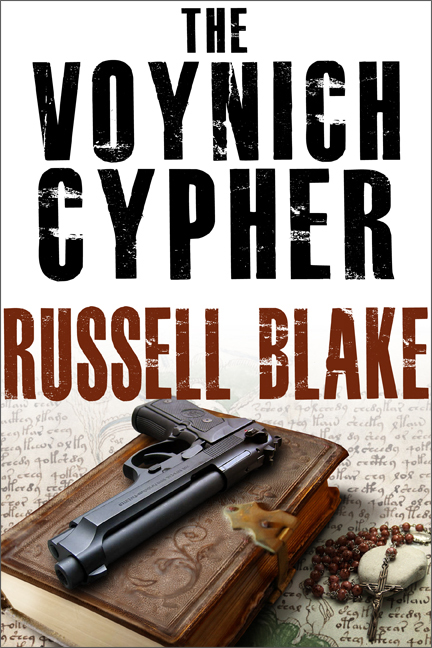
The Voynich Cipher

My latest book, The Voynich Cypher, is an action/adventure novel that uses the Voynich Manuscript as the basis of the underlying conspiracy/treasure hunt. I first became familiar with the Voynich years ago, when a friend of mine who is really into cryptography told me about it. It’s 240 or so pages of “quires” (chapters) with fantastical illustrations, written entirely in an unknown language, believed by most of the best cryptologists of the last century to be a cypher. It’s never been cracked, in spite of being a lifelong fascination for many notables in the code-breaking field. Controversy has surrounded the document almost since it was rediscovered in the early 20th Century, when it was bought by rare book dealer Wilfrid Voynich in 1912, from amongst the possessions of a recently deceased Jesuit general. It has remained enigmatic and inscrutable ever since, and has baffled and confounded generations of experts. Numerous theories have been advanced on the script, none of them correct, or at least not correct enough to decipher it. From time to time it’s been theorized that it was written in a hoax language, but those notions were debunked by rigorous study of the nuance of the text, which is far more sophisticated than any hoax would have required, or than would have been possible to create in the 1400s.

Authorship is a hotly debated aspect of the manuscript. Speculations have abounded – everything from 13th century father of modern science Roger Bacon, to Shakespeare (Francis Bacon), to flim-flam men, con artists and rogues. The truth is that nobody knows. The vellum was recently carbon dated to the mid 1400s, so it is in fact what it appears to be: a medieval document of unknown origin apparently written entirely in code or some unknown language, which chronicles medical, astronomical and botanical knowledge, if the illustrations are any indication. The Voynich Manuscript is truly one of the world’s most inscrutable mysteries, and is the most viewed document at the Beinecke Library at Yale University, where it has resided since the 1960s.

When I decided to try something different than the conspiracy thrillers I’m known for, I started looking around for a mystery. I wanted something that was genuine and verifiable that I could twist and mold into an entirely plausible story. The Voynich occurred to me almost completely by accident – I was reviewing candidate possibilities, and one of them was mentioned alongside the Voynich. That triggered my recollection of long discussions with my buddy, and I was on the road.

I wanted to create an enduring modern fable, something that was both social commentary and adventure, and that was completely non-disprovable. That’s a tall order, and became taller still when I began researching all the aspects of the saga I wanted to include. Months went into everything from Roman geography and arcana, to the Voynich itself, to numerous cryptography tomes, to the various authorship theories (I read several books that made logical, but ultimately incorrect arguments), to the history of the Catholic Church, to the Rosicrucians and Templars, to medieval secret societies, to Masonic lore. I put the book aside several times to write others, but always returned to it, drawn by what I felt is a compelling tale.

The Voynich Cypher is a special novel for me, because it represents my desire to spread my wings and attempt something I’ve always wanted to do, but never felt I had the chops for until recently – to write a Foucault’s Pendulum sort of book that a modern audience could relate to easily, but that didn’t pander. That type of book is hard – it’s difficult to move a plot along at breakneck pace and keep things unexpected at every turn, while imparting a tremendous amount of detail, and writing it was a challenge I’m glad I stepped up to. My hope is that readers who enjoy Dan Brown or Cussler’s work will enjoy Voynich, and that it will be compared favorably to their efforts.

Buy The Voynich Cypher: amazon

Visit the author’s website | follow him on twitter | facebook