The Veil War

"and then I was like, 'Holy crap, goblins!'"

Subcommandante Mumbles vs. The Dinosaur Nazis

This is a silly story. I admit. Some friends were joking around and one line caught me funny – and this story was born. I’ll post one section each day, about 500 words a pop. Enjoy.

P.S. Click here to get see all published episodes of the Saga of Subcommandante Mumbles.

Update

Hey! There’s a new pope! For those who are Prophecy of Saint Malachy followers, he wasn’t named Peter and doesn’t seem to have any Peter-type connections. So, we probably won’t get to see Rome in flames. At least not for that reason. In other news, the delayed bonus chapter is nearly done. I’ll probably post that tomorrow morning. But in the meantime, I have a special double-extra-plus bonus:

A new serial!

This is short story, but since posting things serially is kind of my thing, I’ll just run with that. I’ll post a short section of the story every day until it’s done, for about two weeks, starting today, in a few minutes.


The Really Big Idea: Ian Healy

Superpowers are the heart of science fiction and fantasy. Whether the source of super-human ability is magic, technology, genetics, hand-waving or even pure pluck and gumption – sf examines worlds where people have extraordinary abilities. Since this sort of thing is so very common the trick, then, is to provide an entertaining and plausible explanation for these gifts… Batman’s monomania, nanotechnology, that ancient spell book, heredity. And the trick within the trick is to provide meaningful limits to power that grow out of your explanation. Here’s Ian to describe his world:

Day of the Destroyer

My forthcoming book release, Day of the Destroyer, is yet another foray into the weird and wonderful world of parahumans and their astounding and amazing abilities. Also, alliteration. Day of the Destroyer is set in 1977, well before researchers have begun to understand the science behind parahuman abilities within the Just Cause Universe novels, but it’s something I’ve put quite a bit of thought into, and wanted to discuss some of the ideas I have about how these powers can exist.


DayoftheDestroyerEbookCover

“Superhuman” abilities have existed in some form or other throughout recorded history. Stories and legends abound of men and women with godlike abilities. Hercules. Moses. Paul Bunyan. Pecos Bill. John Henry. In the Just Cause Universe, these legends have some basis in fact, and these people are parahumans. In The Archmage, for example when the [SPOILER AHEAD] heroes have traveled back in time, they meet a man who thinks Juice is John Henry because they look so similar. Is it because John Henry may be an ancestor of Juice? They also meet Mustang Sally’s great-great grandmother, and witness that she has slightly greater-than-human speed. Indeed, both Mustang Sally’s mother and grandmother have speed abilities, which suggests that parahuman abilities are hereditary. In the JCU, that led Japanese researchers to eventually isolate the genetic markers which are common to parahumans.

So parahuman powers are mixed into our genes. But how does that explain such a wide variety of abilities? In the first novel, Just Cause, here is a brief list of the abilities represented on the Just Cause team: super-strength, absorption of electricity, invulnerability to physical damage, flight, telepathy, super-speed, and the creation and control of force fields. How can all these things be tied into a single genetic marker?

It comes down to three aspects, all closely tied together; a perfect storm that allow parahumans to do such wonderful things: dimensions, energy, and psionics.

Dimensions. The idea of parallel universes and dimensions beyond the three cardinal dimensions (plus time) has been around for a very long time. Some theories get kind of wacky with it. Bosonic String Theory, for example, requires no less than 26 dimensions. I’m postulating that one of these dimensions or parallel universes or alternate planes of existence provides the source of parahuman abilities. In what way?

Energy. Energy is, at its simplest, the ability to do work. And if you have a lot of energy, you can do a lot of work. The dimension that originates parahuman powers is jam-packed full of energy. In fact, there’s no matter in it at all. It’s a dimension of pure energy (Cue the Information Society video for those of use who spent our formative years in the ‘80s). I’m conveniently ignoring the idea of the Zero-Energy Universe here, so don’t bring it up, punk. All that energy has the ability to do work, and that work can take a variety of forms. Since there’s an entire universe’s worth of it, it will take quite awhile for the parahumans to use it all up. Since that dimension/universe/what-have-you has no entropy of its own, the only way it can reach a lower state of energy is for that energy to be drained out, and that requires…

Psionics. Psionics is a fancy name for mind powers. Ultimately, in the Just Cause Universe, every parahuman with the appropriate genetic marker has a mind-power that allows them to drain energy from the alternate dimension and make that energy do work. Everything else is just special effects. How does Juice lift up a car and throw it? He might appear to be using his muscles, but in reality, he’s channeling energy from the other dimension to do that work. Doublecharge can fly, Crackerjack can laugh off physical harm, and Mustang Sally can run at supersonic speeds, all because they can control this extradimensional energy on a subconscious, psionic level. So why do parahumans have the abilities they do? Why can’t Juice also fly, or run at the speed of sound? Why can’t Mustang Sally shoot lightning bolts?

Therein lies the real mystery, and one which I may explore further in a later novel.

Buy Book: from ian | amazon | barnes & noble | smashwords

Visit the author’s website | follow him on twitter | facebook

Minor Delay

Your bonus chapter is written and complete, but not edited. I hope to post it late this evening or tomorrow morning at the latest. FYI.

Also, may have a nice surprise next week.

The Really Big Idea: Vanna Smythe

My dutiful and obedient twitter bot (at least, until it takes over the world) has connected me with literally thousands of people. It is a good robot. But one day, not too long ago, I really thought it was screwing with me. One of the new followers it had found me apparently had written not one, but two books whose titles included the word “Veil.” Well, my heart just stopped. Had I been beaten into print by this Vanna person? Had she created a world not only with Goblins, Explosions and Marines, but also Love and Duty? Happily not. There appear to be very few Marines, Explosions or Goblins in this Veil. Maybe I should add some love to mine…

Can the Heart and Mind Function Separately?

The main theme, problem, conundrum that plagues the characters in the Anniversary of the Veil Series is the choice between duty and love. On a more whimsical level, this translates to the choice between following you heart versus following your reason, your mind. And the further question, which then arises is: Can there be balance if one is forced to make this choice so cleanly?

This question plagues me, the writer, as well, but it took me quite a while to come to the realization that this question is at the core of my series.  I am more of a pantster when it comes to writing, and trust that any deeper meanings, significance and questions I struggle with will be there to find once I tell the story I want to tell, with the characters I want to create.

So, Duty vs. Love in the Anniversary of the Veil series …

FinalBookCoverProtectorFixAmazon72dpi

In our lives, love comes in many variations: mother/father to child, man to woman, teacher to student, self-love, … so I have not placed any limitations on it in my series.  But the thread that runs through it all is that in each instance the man or woman involved must choose between it and following their duty and cold reason.  None of them can have both.

Protector Kae must decide whether to stay a Protector or follow Princess Issiyanna, the girl he loves, on her quest, which would make the first impossible.  First Captain of the Protectors Entan must decide between sacrificing Kae, whom he regards as a son, to the scheming of Head Priest Rhaldan, or force Kae to flee and thereby going against his oaths and his duty. Keeper Alet must choose between following her orders and sacrificing her sister’s daughter, Princess Issiyanna, for the greater good, or forsaking her duty and saving her niece. And Princess Issiyanna must choose between leaving her whole world and everyone she knows and loves behind to be with her one true love, her other half.

Yet a clean-cut choice like this is difficult, especially in a world such as the one these characters inhabit, namely one that is artificially separated into two by a Veil, which none may cross at will.  The worlds on either side of this Veil are completely different, and the bigger choice in the series is between allowing the Veil to continue to separate the worlds, or letting it fall and allowing the world to become one once again.

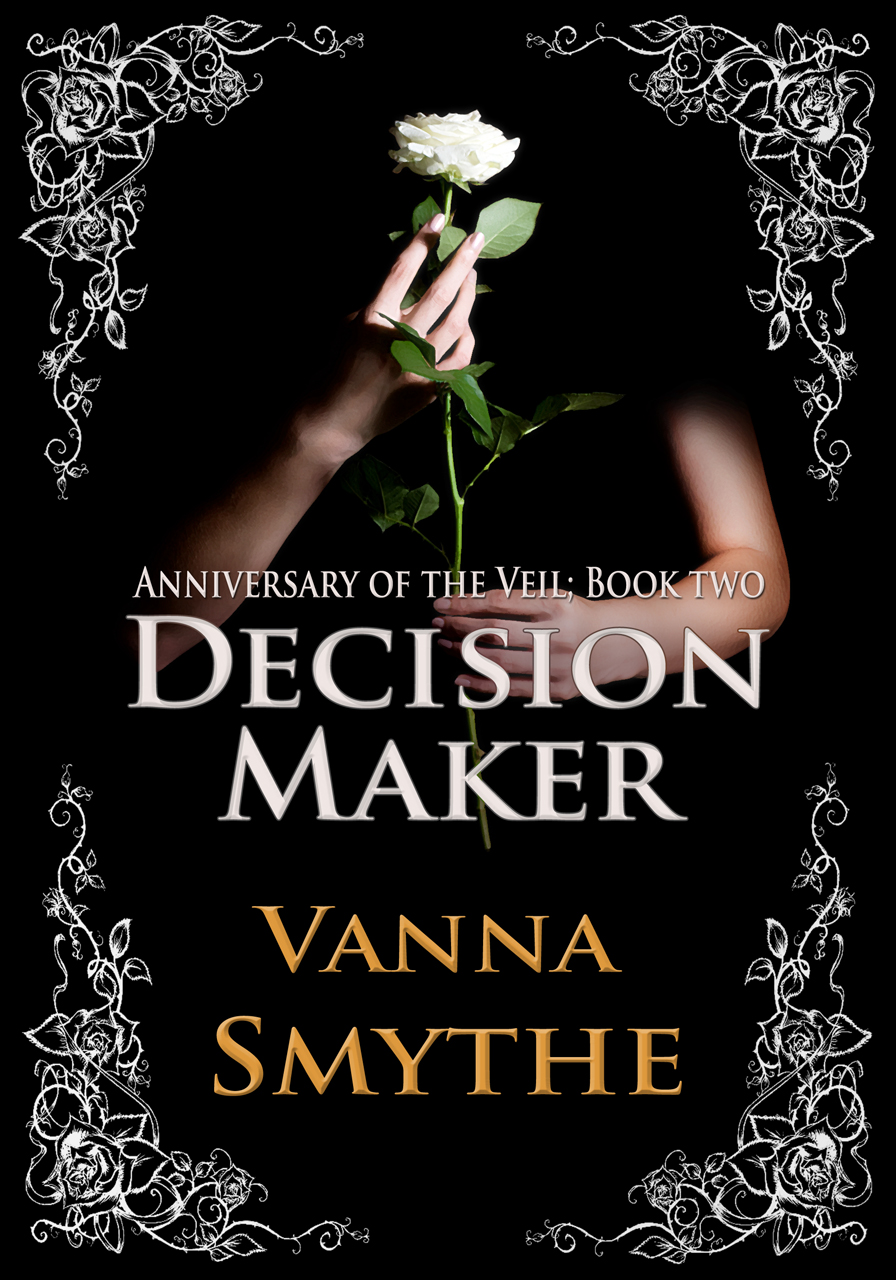
As of the end of the second book in the Anniversary of the Veil series, Decision Maker, most of these choices have been made, for better or worse. I will not go into the details here, as I don’t want to give it all away, but I will say this: I do not believe that clean-cut choices between love and duty are ones we can make without unplanned consequences.

In our (Western) culture I have often observed a sort of inability to weave our heart’s desire into the choices we make. Society dictates a certain path for us, which starts with finishing school, getting a job, getting married and having kids, and then working on keeping it all. And if those things are not precisely what you want, well, there will be time later to indulge in your dreams. Right? I don’t know, maybe.

Within reason, I do not believe we should ever disregard what our heart tells us is the right path, and I also do not believe that we can truly do so. No matter how much we pretend to the contrary. One way or another, this is also what plays out in the lives of all of my characters in the Anniversary of the Veil series, after they have each made their choice.

Decision Sml
Book One and Book Two of the Anniversary of the Veil series, as well as a free ebook sample of the series, are available from Amazon and other online retailers. Book three is coming this summer!

Buy Books: amazon | barnes & noble | itunes | kobo

Visit the author’s website | follow her on twitter | facebook

The Really Big Reminder

Just so you don’t forget, we’ve now done quite a few of these Really Big Idea posts, going back to over a year ago. I still haven’t read all of them (shame) but every single one of the ones I’ve read has been simply fantastic. So give them all a shot at your attention, and your wallet.

If the spirit moves you share a link to this page, or to the posts of the authors you’re most interested in. Let’s help some indie authors.

This is the end

Chapter 36 is here, and here is the end of this part of our tale.

“Your family’s mostly in Alabama, right?” Coleman asked.

“Far enough from the Veil for now, yeah. For now. Chicago, New York, Washington… Boston’s holding out, I heard. But they were farther away. The whole middle of the country is fucking gone. Fuck, dude, the goblins are camping on the Mall in DC. How do you come back from that?”

According to my calculations, Lewis’ story runs to 94,321 words. The bonus chapter next week will take us to within a loud shout of 100k. That, I believe, is a respectable amount of fiction. By weight at least, it’s a novel. I’d like to thank all of you for reading, and I can say in all honesty that your participation in this project made it far better than it would have otherwise. Thank you.

(And as always, point out errors and the like in the comments. )

And now for something completely different

I have come up with a scheme to combine alternate history, the civil war, steampunk, planetary romance novels and the singularity in one cohesive whole.

There will be aerial ironclads. A global war. Victorian spaceships. (Well, Late Victorian shading into Edwardian Spaceships.) Venusian jungles, the Dying World of Mars and the mysteries of the Jovian Moons. North Polar Adepts. The Ten Thousand Worlds of the Martian Old Ones. And one small boy.

You may applaud.

The Really Big Idea: Madeleine Holly-Rosing

I’ve long been fascinated by steampunk, so it is perhaps strange that I’ve read so little of it. The first steampunk novel I ran across was The Difference Engine by Gibson and Sterling. I read it because of the authors’ previous work, but loved the world they created, a world where Babbage’s engines created a world infested by computers a hundred years ahead of schedule. There is something about the Victorians, a something that Neal Stephenson captured in a book set not in their own era but in the future. The Neo-Victorians of the Diamond Age were a conscious reaction to the follies of our era. (And if you read closely, the grandfather and Equity Lord who is the instigator of most of the action in the story is probably about 40 right now.)

While we may like the clothes, the industrial design, the steam engines; what fascinates me is Victorian confidence, the assuredness with which they lived. They knew they could solve problems, conquer worlds. And so they did. Our modern temporal parochialism insists that because they did not share our concerns they were benighted, bigoted, backward. So what would they do if they had mechanical computers, airships and Tesla death rays? Fascinating things.

Madeleine, though, is looking at other aspects of the Victorian Era. And between this entry and last week’s, I have a lot of steampunk to read.

Boston Metaphysical Society

When Stephen asked me to write this blog for his website, he seemed to be particularly excited this week’s guest would be talking about a webcomic.  I secretly think all he wanted was the pretty pictures and I’m happy to oblige. But be forewarned, writers are writers no matter medium we write in. However, I digress…

BOSTON METAPHYSICAL SOCIETY (“BMS”) is the name of the webcomic and for those of you who are not familiar with it the story is about an ex-Pinkerton detective, his medium/spirit photographer partner and a scientist who battle supernatural forces in late 1800’s Boston. Yes, ladies and gentlemen, it is a steampunk webcomic though in some circles it has been called steamgoth. (Think steampunk with paranormal elements.)
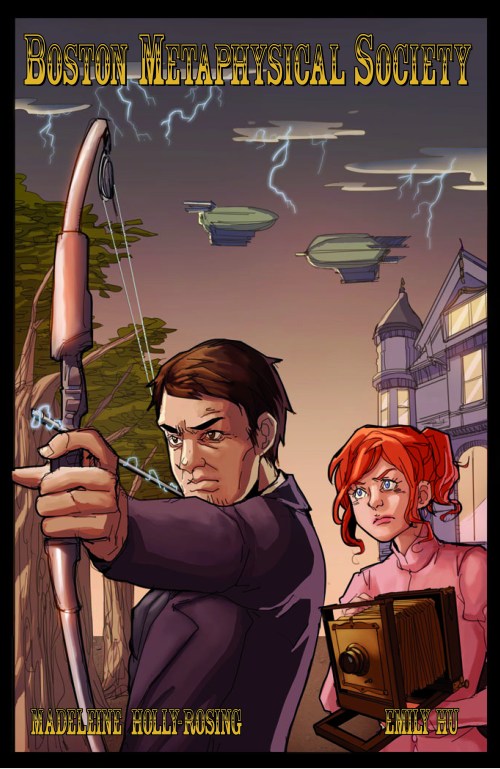
BOSTON

What the heck is steampunk, you ask? Well, some people define steampunk as late 1800’s Victorian science fiction, i.e. Jules Verne. However, I think it evokes the time period in fashion, culture, technology and innovation. I also don’t believe it has to be set in Victorian England. If you do a search on Google, you can find steampunk stories and fashion that are influenced by other cultures and geographical locations. For instance NEXT TOWN OVER is a western steampunk webcomic. On Facebook, there are steampunk groups from every point on the globe. It is probably the most inclusive genre I’ve ever worked in but most of all, it allows people to be creative and express themselves as individuals without any hard and fast rules other than it must vaguely relate to the Victorian era.

I fell into steampunk by accident or rather it almost fell on me in the form of a former UCLA classmate by the name of Alex Diaz. He was in the MFA directing program while I was in the MFA screenwriting program and we met in a TV development class. I was developing BMS as a TV Pilot when he dropped down next to me on the couch in Melnitz Hall and uttered the words, “Steampunk.”  My reaction was like “OK and that’s supposed to mean???” He explained it and said he thought BMS should be set in a steampunk world. I thought it sounded interesting, so I did a lot of research, reading and determined he was right. I’ve been a huge science fiction and fantasy fan since my mom read me A WRINKLE IN TIME as a kid, so steampunk wasn’t really a stretch. I’m also a fan of period drama and watch BBC productions religiously. So, I re-developed the story and eventually adapted into it a six-issue comic mini-series.

All of the above is the short version of what you see on the website or the print edition on how this story came to pass.  However, the themes and issues dealt with in the comic have as much or more to do with my own fascination with class distinctions and social mores than anything else.

Characters who are derived from different classes have built in conflicts which are a huge plus for a writer. Societal expectations are different for the men and women of each class. Two very good examples of this are the TV shows SPARTACUS and DOWNTON ABBEY. How can you dare put these two shows in the same sentence, you ask? One excels in blood, lust (and blood lust) hard bodies and lots of naked people with a show which has very pretty polite people who remain fully clothed and generally argue over tea (except for the WWI scenes).  Easy, like BMS they are about class distinctions and expectations.

Spartacus and his people are slaves who are fighting their Roman overlords for freedom.  Their society expects slaves to do what they are told and can be bought and sold on a whim. However, even among Roman society there are cultural and societal expectations for men, women, sons and daughters. To challenge these rules of society usually results in something bad happening. In Spartacus’s world to challenge usually results in death. For Romans, the result can also be violent if a wife or child challenges their husband/father who is the defacto representative of Rome within the household.

The society and culture at DOWNTON ABBEY also has a clear set of rules. Don’t date the help. Marry within your class. If you’re a woman, you cannot inherit. If you’re an aristocratic man who can’t afford new plumping for the estate, forget about marrying for love you have to marry money. Arrogance and political position will often ride roughshod over any who think differently.  Here, the Earl is the defacto representative of the crown who is the one who decides the family’s fate.  Obviously, the Earl’s character is not one to lop off heads, but his influence is just as powerful as any Roman patriarch.

I’m not here to yammer on about the evils of patriarchy because many people, before and after us, find great comfort in knowing where they belong in the scheme of things. They wouldn’t dream of challenging the status quo because it tells them how to behave and what to expect from life. However, when those expectations are not met then you might run into a revolution or two.

All of the lead characters in BMS have or will challenge the social norms for the day. That is one of the most fun things about writing them. If they stayed put and led a “normal” life for someone of their class there would be no story. These characters are firmly grounded in their class yet on occasion they challenge it. Sometimes they will be rewarded for it, but they will also pay a price. Maybe not now, but later.

One of my favorite panels (see below) is after Caitlin curtsies to Granville and his response. For one brief moment she has crossed racial barriers and given him the respect he deserves, not only as an educated gentleman, but as a courtesy to a fellow human being. He responds in kind even though she doesn’t believe she deserves it.

BMP-1

Another panel demonstrates the utter disregard of Jonathan Weldsmore for his servants’ well-being. His only thought is for his political and social standing.  The next panel (not here) shows Caitlin becoming angry, but she can do nothing about it.  Though she is a necessary to these people, her presence is neither wanted nor desired for three reasons: wrong class, wrong gender and she has psychic abilities.

BMP-2

Even Samuel is caught between a rock and a hard place because of his social standing.
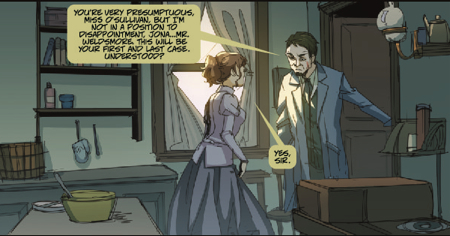
BMP-3

In future chapters, we will see more of Caitlin’s mother, Erin, who is so entrenched in her social class that she will do anything to stop Caitlin from “over stepping.”  Members of B.E.T.H. will also challenge and be challenged by their own prejudices and presumptions.

Class defines how we were raised and our world outlook.  It is a theme that has bled into almost everything I have written including the novellas.  My question to you is what themes have permeated your writing and where did they come from? Understanding that will help you be the writer you are meant to be.

Read the webcomic | buy dead tree version | buy novellas and short stories

Visit the author’s website | follow her on twitter | facebook

THE CLOCKWORK MAN (A BMS Short Story) is available in the February issue of eSteampunk. THE WAY HOME (A BMS Short Story) will be published by Atomeka Press in September as part of a comic anthology.


Peering into the future

The end is in fact near. With the decision to post chapter 36 in its entirety, the final chapter of the Veil War will post in less than a week. Does this mean that there will be nothing more to read, forever?

Not quite. There will in fact be a bonus chapter posted the week after. Material that was cut from Part I (in a series of maniacal editing binges occasioned by the harsh criticism of Ian Healy) has been revamped, polished, wrapped in a bow, set upon a velvet cushion and will be restored to a more appropriate location. To wit, right after Chapter 17. This interstitial chapter is a big one, approximately equal to two (2!) regular chapters. So there’s that.

But every ending is just a beginning somewhere else. So what else? Right now, I’m editing the entirety of the Veil War – both the parts you have seen, and that which remains unseen. Preparing it for publication. This will take some little while, given my work and commuting schedule. But in the not-too-distant future, The Veil War will leave the nest and be sent somewhere so that eventually you might buy it. At this point, I’m still wavering between the Scylla of self-publishing and the Charybdis of traditional publishing. I don’t know exactly how that will work. But I’ll keep you updated. (Hint: I’m leaning towards self-publishing, which should allow you to own your very own copy of the Veil War sooner rather than later.)

Now you may be asking, “When will I get more rollicking, exploding, profanity-filled adventures to occupy my lonely Thursdays?”

Soonish. After I finish the editing, I am technically free to immediately dive into The Veil War, Volume II (TVWVII). I will make that dive, but probably not until summer. I want to write some short stories and submit them to actual, paying venues. One is already complete, and two more are under construction. I intend to churn out a fair number of these because: money, practice, fun, money, and to clear my head a bit before returning to the Veil War. But also, and more importantly, because of a promise to my son.

The first several excuses should be fairly self-explanatory. The last one deserves some little comment. Back when I first started writing the Veil War, my son was obsessed with the idea. He woke me up an hour early every day so that we could talk about it. And he had a ton of ideas. Whole bulk-cargo ship loads of ideas. Most of which, sad to say, did not fit the Veil War’s unique and special idiom.

They weren’t bad ideas. In fact, rather the opposite. The unbridled id of an bright eight year old boy fed on steady diet of nature documentaries, violent cartoons, and a thin sprinkling of scientific knowledge can come up with some wild shit. In fact, the boy became upset the more I told him that his ideas didn’t fit the Veil War. (Son, where am I going to add a fifteen-mile long dreadnought of space with particle beam weapons that can boil oceans? Where?) So I promised him that after I finished the Veil War, we’d write stories that had room for all his ideas. In a universe not constrained by the prejudices of gun-forum habitues. I encouraged him to just cut loose. I took notes. And damn me if the result isn’t the framework for a freaking awesome Space Opera.

Galactic scale war, vast fleets, starkly unimaginable forces harnessed for the destruction of worlds. You know, the typical. But there’s more.

Some of the short stories will be set in that world. And I’ll be splitting any profits with the boy.

So, to sum up:

  • One more chapter
  • Bonus, double-length interstitial chapter
  • Hiatus (behind the scenes editing)
  • Short Stories!
  • Veil War II

My thinking on short stories is that I’ll try and get each one published maybe twice. Anything that doesn’t stick for whatever reason, I’ll throw up here. Once I have a decent number, I’ll bundle them and put the result up on Amazon. Obviously, I’ll keep you posted on that front, too.