The Veil War

"and then I was like, 'Holy crap, goblins!'"

Month: January, 2012

Welcome

There’s been a significant uptick in traffic over the last couple weeks. I am pleased that all is proceeding as I have foreseen…

To all the new readers, welcome! I hope you enjoy the Veil War and tell all your friends.

~

And a general informational message:

I thought I might take a moment and talk about drafts. What you are reading is not a first draft. But neither is it a finished product. What it is is about a draft and a half. What happens is: I write. Then I go back and look for obvious mistakes, correct things, smooth things out a bit, and generally make a decent first pass at editing. The penultimate stage is my wife doing a quick copyedit; checking for spelling errors and rapidly proliferating commas. Then, you read it.

Right now, I’m doing an actual, serious rewrite of chapters 1-8 so that by the time my cover art is ready I’ll have something that I can put up on Amazon that will be as good, and as free of error, as I can possibly make it.

There are two things to know about me and errors. One, I hates ’em. Two, I makes ’em. You can help: by pointing out errors of fact or imagination, typos, bloopers, mistakes, grammatical and syntactical infelicities and wtf? moments. Or just by making suggestions for improving the story. Hell, even asking questions often makes me think more clearly about what I’m writing. Point out errors in the comments, or send me an email at thestephengustav [at] gmail.com. I embrace criticism. I give it a hug and tuck it in at night. Because it’s the only way to get better.


Creatures of Myth

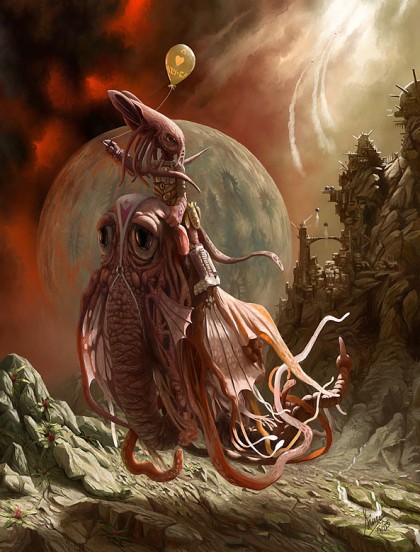
A Twitter follower, @DigitGeek volunteered an image he did a while back:

It doesn’t really map to the Veil War, but I thought it was cool and asked if he had more. And perhaps unsurprisingly, he did. Here’s a couple more:

The Really Big Idea: Allison Dickson

I can see how vampires can be funny. Anyone who has ever seen the movie Vampyre can’t believe otherwise. (Strangely, I can’t find any evidence on the internet that that film ever existed. I will admit that I was very drunk when I saw it, but I did see it.) Creating funny vampires on film merely requires a lack of talent and a lot of money. On paper, it’s a different story. Here’s author Allison Dickson explaining how she came to write a story about a Vampire Mailman:

Vampires in Chagrin Falls

I never would have thought to sit down and write a funny vampire book if it hadn’t been for two things: my husband and Douglas Adams. The former is a huge fan of the latter, and it was because of this (and the certainty I was missing out on a whole treasure trove of his inside jokes) that I finally cracked open Hitchhiker’s Guide to the Galaxy and proceeded to laugh my ass off.

I started to think about the concept of the book and how I could adapt it to my particular writing style. I love satire, so that part was going to be easy, but I needed a meaty target. I decided on vampires because they’re so damn ripe for it. There are so many well-established tropes and “rules” to bend, break, or adapt to whatever social commentary you want to make. I also wanted to do my own version of a “book within a book” that Adams did so well in Hitchhiker’s Guide, so I created Dexter Bloodgood’s Guide for Modern Vampires and included little snippets of it at the beginning of each chapter.

The next hurdle was to come up with characters. Louis Cross is the sort of “Arthur Dent” character, a hapless everyman who has all of these crazy things happening to him and is surrounded by eccentric people who are ultimately far more interesting than he is. Some people criticize this method of character building, but I think it works well for certain types of stories. The secret is that the main character has to know he’s boring. It also increased Louis’s sense of confusion and exasperation when all these nutty things started happening to him. Like becoming a vampire and discovering his doctor injected him with it. And then there is of course his lovable redneck intellectual best friend, Stan, who never seems surprised by much. And that’s a mean feat considering some of the shocking things that happen over the course of the book. You’ll have to read it to find out. 🙂

That brings me to what I think was the biggest hurdle with Scarlet Letters:  the plot. It’s frustrating to have this concept and these characters and these funny jokes, and then have no clue what to do with them. There had to be a hook to pull the conflict along, and try as I might, I couldn’t find it. It had to mean something, and it absolutely had to have a certain level of action. It was why, after starting the book, I ended up putting it down for a year and focus on something else. Sometimes that’s necessary. I don’t believe in forcing the issue. If you do, it’s a bit like stripping a screw.

When I did finally come back to it, I read what I had from the beginning, and the plot suddenly revealed itself to me. It was like one of those hidden 3D objects in a picture that you don’t see unless you’re staring at it a certain way. I wound up cutting out most of the first act and rewriting the second act. A few more pivotal scenes and character revelations later, Scarlet Letters: The Tale of the Vampire Mailman was born. And it was a particularly wonderful feeling, because it was my first completed novel. It underwent a lot of edits after that. Sometimes I feel like I could recite it word for word.

Anyway, I was lucky to have a lot of fans of the story. Enough to make me consider writing a sequel to it sometime later this year. And because I’ve had more practice writing books since then, I pretty much have the plot mapped out. At any rate, I can’t wait to meet my friends in Chagrin Falls again, and I hope more folks out there discover it.

Buy Scarlet Letters: The Tale of the Vampire Mailman: amazon | barnes & noble | smashwords

Visit the author’s website | follow her on twitter | facebook

The Limitations of AI

Anomaly UK has a had a stellar series of posts on AI you all might find interesting: herehere, and here.

But what is “human-like intelligence”?  It seems to me that it is not all that different from what the likes of Google search or Siri do: absorb vast amounts of associations between data items, without really being systematic about what the associations mean or selective about their quality, and apply some statistical algorithm to the associations to pick the most relevant.

There must be more to it than that; for one thing, trained humans can sort of do actual proper logic, about a billion times less well than this netbook can, and there’s a lot of effectively hand-built (i.e. specifically evolved) functionality in a some selected pattern-recognition areas. But I think the general-purpose associationist mechanism is the most important from the point of view of building artificial intelligence.

There are good reasons to suspect that human intelligence is very close to being as good as it can get.

One is that thinking about things longer doesn’t reliably produce better conclusions. That is the point of Malcolm Gladwell’s “Blink” (as far as I understand it; I take Gladwell to be the champion of what Neal Stephenson called “those American books where once you’re heard the title you don’t even need to read it”).

The next, related, reason is that human intelligence doesn’t scale out very well; having more people think about a problem doesn’t reliably give better answers than having just one do it.

The major limitation on human intelligence, particularly when it is augmented with computers as it generally is now, is how much it is wrong.  Being faster or bigger doesn’t push back the major limitation unless it can make the intelligence wrong less often, and I don’t think it would.

What I’m saying is that the major cost of human intelligence is not in the scarce resources required to execute the decision-making, but the damage caused by all the bad decisions that humans make.

The major real-world expense in obtaining high-quality human decision-makers is identifying which of the massive surplus available are actually any good.  Being able to supply vastly bigger numbers of AI candidates would not drive that cost down.

It goes on and gets more interesting from there. Read the whole thing.

I found this bit from the second post particularly enlightening:

All this relates to another long-standing issue in our corner of the blogosphere: education, signalling and credentialism. The argument is that the main purpose of higher education is not to improve the abilities of the students, but merely to indicate those students who can first get into and then endure the education system itself. The implication is that there is something very wrong with this. But one way of looking at it is that the major cost is not either producing or preparing intelligent people, but testing and safely integrating them into the system. The signalling in the education system is part of that integration cost.

A test of the Emergency Veil War Broadcast System

I just sent out an an email to everyone who subscribed to the Veil War, and to everyone who is a friend of the Veil War on Facebook. The bonus story is being delayed – the short explanation is that I want to make it better, and it’s not better yet.

The system in place now is less than optimal, I think. I don’t have emails for everyone – so it is difficult to communicate with the nearly one hundred people who have become official™ fans of the Veil War. Some messages were sent with Facebook’s messaging system – but for some reason I couldn’t message two of the people who friended the Veil War. (Bob Davis, Daniel Zazitski – drop me an email and you’ll get my personal groveling apology. If you feel that you should have gotten a groveling apology, and didn’t; let me know and I’ll create a special groveling apology just for you.)

Before the Christmas break, I was talking with my friend Chris about setting up a better system for communicating with you, the reader. It is clear that now that is a real necessity. So over the course of the next couple weeks, expect to see some changes on that front. Once we get that in place, we’ll have more information.

In the meantime, enjoy these videos of the A-10 blowing shit up:

Veil War Thursday Is Back

The New Year is here, and I hope it finds you healthy, prosperous and possessed of a desperate need for more Veil War. And if that does happen to be the case, today is a good day for you. Because today Chapter Nine of the Veil War makes its appearance.

Your traditional teaser:

“Captain Lewis,” the Prince said through the interpreters, “Yes. Tend to your wounded. Send a dozen men with beasts of burden down to the valley, that we may share the spoils of battle. You and your officers may join us at sundown. Then, we will eat; and we will plan. Our presence here in this world can not have gone undetected, and we will have to move quickly.”

Today is your lucky day, too, if you sign up to be an email subscriber – scroll down to the bottom and click where it says, ‘Follow the Veil War via Email’ – or befriend the Veil War’s Facebook page. Because if you do, you’ll get the bonus story that has been kicking my ass for the last week. You may have only hours left. Act now while supplies last!

That’s four digits, dude!

Sometime over the last couple days, the Veil War’s total following crossed into four-digit territory. As its stands right now, we’ve got 1295 followers. I think that’s awesome.

In other statistics news, we’re over 5,000 cumulative site views. And nearly 200 of you have gotten as far as Chapter 8. I think that’s awesome, too.

Thanks, everyone, for reading. You are all beautiful and unique snowflakes, no matter what Chuck Palahniuk says.

The Really Big Idea: Steve Umstead

Steve Umstead has been exceedingly generous in providing helpful advice to me in the short time that I have been above water as an author. So naturally, I asked him to help some more… But at least this time, we have the thin fiction that this is self promotion for him. The Gabriel story is the kind of thing that I always imagined that I would be writing when the time came. Space ships, action, conflict, and intrigue. Science fiction in the classic mode. Sometimes, an image in your mind can be a powerful thing even if you don’t realize its power at the time. The key is that if that picture in your head is true, then what you make of it at least stands a chance of hitting a chord with your readers. Three Gabriel books is perfect proof of that.

Gabriel’s Genesis

When Stephen approached me a few weeks back about participating in this modified version of The Really Big Idea, my first thought was, “I never had a really big idea,” so what could I possibly contribute? As I thought more and more about it, I realized that way back when, I did have a Really Big Idea about what became my debut novel, Gabriel’s Redemption. It’s just that way back when, I had no inkling that little scene floating around in my head would turn out to be an idea that blossomed the way it did.

You see, a little over a year ago, I had no story, nor plans to publish a novel. I had always wanted to write, since a very early age, but had never sat down and written, from start to finish. I had plenty of first chapters I thought were incredible; I edited them to death, and subsequently lost interest as real life moved in to take over my focus. So I never finished.

Flash forward past my 40th birthday (the year at which point I always thought I’d be rich and famous by…not quite) to October of 2010 and my plans to jump into the following month’s National Novel Writing Month challenge. I decided once and for all to sit down and finally finish a story, but I needed that Big Idea. The scene that had been floating in my head for decades (yep, decades…) reared its head, and Gabriel was born.

The scene is quite simple, actually, and at the point when I sat down to write it, I really had no clue what it would become. It’s a short scene: a disgraced Special Forces soldier, haunted by his past, dreaming of a happier day in his childhood with his family, brought out of the dream by people who want to bring him back to his present, with a chance for redemption. From that scene, I created the character and his background, his mission and its challenges, his flaws and his strengths. They all grew from that one tiny little chapter.

Once that book was completed, and published, and started to get good feedback, I looked back at that tiny little scene and realized I could do much more with it. And so a trilogy was born, the characters continued to be developed, the plot arc was extended, and came full circle with the final scene of the final book.

I get the question of, “where did you get the trilogy idea from?” a lot. And my honest answer is I don’t know, at least for that first scene. But as for the complete story, it all came from a guy in a ratty Jamaican hotel room, dreaming of better days. Go figure…

Buy Gabriel’s Redemption: Amazon | Barnes & Noble | Smashwords

Visit the author’s blog | follow him on Twitter | Facebook

I haven’t forgotten you

To those of you who may be wondering, “Where is my goddamn bonus story?” I have a variety of excuses/explanations/red herrings/non sequitors for you:

  • It really is almost done.
  • I haven’t forgotten
  • I was drunk until mid afternoon Sunday. Not because I kept drinking, but because it took that long for what I drank the night before to wear off.
  • Hey, look, squirrel!
  • Two words: Minecraft. Did you know that with the zeppelin mod and some clever usage of window panes, you can make a really awesome ghostly sky-galleon?
  • Your bonus story is going to end up being a bit longer than I initially planned. In fact, probably four times longer. Longer than a normal chapter, even.
  • My family is relentlessly incapable of understanding that when I sit down to write, I am not to be disturbed. I plan in the very near future to move my office to a much more inaccessible location. Like Mars.
  • Your regularly scheduled Veil War Thursday chapter is already ready.

I hope that this post reassures/distracts/ameliorates your pain as appropriate.

This would also be a good time to email subscribe (scroll down to the bottom of the page) or befriend the Veil War Facebook page so as to get the story.