The Veil War

"and then I was like, 'Holy crap, goblins!'"

Goblins in Space!

Okay, not really. But in the interest of providing quality content and getting you ready for tomorrow’s really big idea post, here’s a link to an interesting and long discussion on war in space over at perfidy.

Orion Drive

The exception to much of the mass considerations discussed above is the nuclear pulse, or Orion drive.  This concept involves building a very large ship with a heavy base plate attached to the back of the ship by some very serious shock absorbers.  Then, you light off a small nuke behind the ship.  Repeat as necessary.  This is an over-the-top propulsion scheme.  With this, you could accelerate very large masses very quickly.  Ships using an Orion drive would simply have to be big just to make the acceleration survivable.  Since you need a big ship; adding armor, huge power plants, or anything else you want is not such a big deal.  An Orion powered warship would be a huge hulking brute.  It would not be subtle, and stealth would be a lost cause.

No other type of spaceship (based on current technology) could match the Orion for speed and payload.  It will be in a class by itself until and unless someone invents fusion or antimatter drives.  Meanwhile, the inherent limitations of the other propulsion types will limit the kinds of warships that can be built around them.  (As will the existence of Orion powered warships.)

Chapter Eleven

And so we come to Chapter Eleven. I’m running out of clever things to say about new chapters. I considered making a bankruptcy joke, but given the current economic situation that might be in bad taste.

I apologize to those readers who may have gotten accustomed to lots of explodey-choppy stuff for the relatively slow pace – trust me, it picks up again in a bit. Here’s your teaser:

Burhan translated for him, “I admit, your Highness, your pavilion is not so comfortable as my palace. But I am not so much older than when I traveled in the Ursene highlands, preaching the Word of God on little more than cold mountain water and stale marching bread. Your table is much more luxurious, and my companions now are not so likely to want to remove my head for a decoration on their fireplaces.”

can’t sleep, clowns will eat me…

Was talking to Russell Blake on Twitter about our mutual loathing for clowns. It occurred to me that I need to replace what was once my favorite tshirt ever. Now worn, faded and torn, this shirt was once my favorite article of clothing:

chalkline150.jpg

I got more comments in an average day wearing that shirt than ever I did with anything else over the whole time I owned it. Seems a lot of people hate on clowns. Which makes sense, seeing as how effing creepy they are. You can get your own shirt and an array of other anti-clown gear here.

And a heads up: Blake is giving away free kindle books. I can’t read, so there’s no point in me getting them. But you might enjoy them.

SOPA Considered Harmful

Being a reactionary monarchist extropian libertarian, I find it hard to become exercised about politics beyond the normal human revulsion at witnessing the venal pandering to the vulgar.

Nevertheless, I rouse myself from my apathy because the SOPA/PIPA acts being considered by the US Congress will screw with my plans should they be enacted. I plan to make a living from the internet. Or at least, make money on the internet. To have to check every outgoing link for infringing material or risk having my own site shut down is a staggeringly retarded imposition.

The world is not perfect. But the internet is pretty cool, all told. If you are a U.S. citizen, tell your congressfucker to wise up, and protect my future. And yours, of course.

You can get more information on the issue in these places:

EFF

Technical Examination of SOPA

Wiki and Wiki

Google

Discussion of SOPA that includes the phrase, “Federal pound-me-in-the-ass prison”.

Representative lookup here.


Publishing Linkage

As you might imagine, beyond the whole problem of writing a novel there is the whole problem of getting people to read it. We’ve discussed that second issue a couple times here already. One of the ways that I’ve been spending the time that I’m not writing is with market research. I’m organizing my thoughts on that, but in the meantime here are some interesting links that I’ve run across that discuss various aspects of publishing – especially independent publishing. If that isn’t your thing, no worries. Just wait until Thursday.

Interesting tidbit from Rusch’s post, Why Not?:

The biggest problem writers have as a class isn’t that they work too cheaply, which I wrote about last week, or even that they don’t understand business, which I write about almost every week, but that they think too small.

Huh? you think to yourself as you read this. My last novel clocked in at 140,000 words. I invented an entire world. I don’t think small.

Oh, yes, you do. Every damn day. It’s the rare writer who actually has ambitions—real ambitions—and stands up for them. It’s the rare writer who not only dreams of glory (bestseller lists, millions of dollars, fame, lasting acclaim, or whatever) but actually works toward those dreams.

I have.

Happy Thoughts

Just an update – the Veil War is, as of 7:30 this morning, at exactly 2000 followers. Also, traffic for January is already up over December.

So all of you just need to slow down because at this rate we will have 256 billion followers in just months.

In other news, @veilwar is still in second place for the Shorties. Which is total bs. Those slimy bastards have clearly rigged the contest for this Sean T. Poindexter – no matter how many people nominate @veilwar and despite Ward’s best efforts to single-handedly swamp their servers, I stay one below that guy. Can he even type? Outrageous.

Thanks, everyone.

The Really Big Idea: Shay Fabbro

I don’t typically dream in color. On the infrequent occasions that I remember dreams at all, I have to make do with more pedestrian B&W. There’s no question though, that dreams have been the motivation for many things. Shay Fabbro has a few things to say about how one particularly vivid dream led to writing.

I Had a Dream

I’m sure I’m not the first author to say this nor will I be the last. The idea for the Portals of Destiny series came from a dream I had while I was still in graduate school (I hold a PhD in human medical genetics). I have suffered from night terrors since I was a child. This particular dream I had was extremely vivid. We’re talking sounds, colors, smells.

In my dream, a man covered head to toe in sweat-stained robes is leading a camel through a desert. No green in sight, just a brown mess of sand and rock. Suddenly, the camel starts to tug at the rope, refusing to move forward. The annoyed man tries to force the camel, and of course as anyone knows who’s ever tried to force a camel to anything they don’t want to do…well, you get the point.

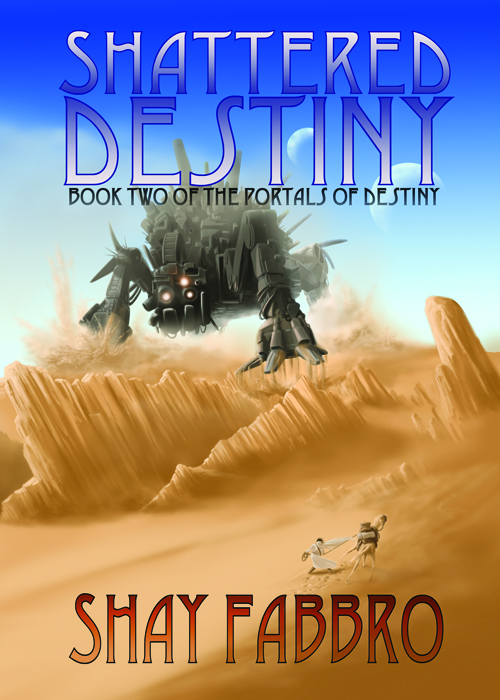
The ground begins to vibrate under the man’s feet and the camel goes ballistic at this point: snorting and pawing the air, finally ripping the rope out of the man’s hand. The man sees a large thing coming his way, with strange red and blue lights flashing, and it’s bigger than anything he’s ever seen. As it moves closer, the noise from its engines begins to become very painful. The ground shakes so badly the man can’t keep his footing. The machine begins to descend, unfurling its legs as it gets lower. The man’s eardrums rupture from the deafening roar of the engines. The last thing he sees is the enormous leg just before it crushes the life out of him.

As you can well imagine, I couldn’t stop thinking about this dream. Who was the guy and what in the world were the gigantic machines? Were they like transformers? Something different? My head reeled from all of the questions. Of course, there were no answers.

Except what I made up in my own mind.

The more questions I answered, the bigger this “dream” became. I talked to a friend of mine who worked in another lab and told her about it over lunch. She thought I should write the stuff down, see where it led me. The idea seemed ludicrous at the time. I mean, I was a research scientist, what the heck did I know about writing a novel?

Suffice to say, I did what she suggested. Before I knew it, I had the glimmer of an idea, something that was different, maybe a little overwhelming, but filled with promise. I embarked on a journey to create a series that was a blend of both scifi and fantasy. Think “Star Wars meets Stargate” and you’ll have an inkling what I mean. I wanted to blend technology, weapons and cool gadgets with prophecy and magic. What I ended up with was a book with twenty-two Chosen (prophecy says only they can destroy the Mekans), four Guardians (one for each planet to guide and protect the Chosen), and one fleet of mechanical beings called the Mekans, who roam the galaxy strip mining planets until they are completely destroyed.

Sound exciting or what?

Well, as I started writing the plot idea, I realized that what I had was much bigger than a single novel could contain. And thus the Portals of Destiny trilogy was born. The biggest part of this whole endeavor was creating the four planets that were home to the Chosen as well as the fifth planet that was home to the Guardians. I had to create five unique alien races and worlds, most of which had to be different from Earth. And on top of that, I had to give unique personalities and voices to all of the Chosen. I spent about eight months or so just designing my planets and the races that would inhabit them. I gave them cultures, histories, drew maps of the world, the villages and towns, and drew rudimentary drawings of the races themselves. My artist did a much better job and you can see his work on my website on the Artwork page. I had to really make sure I had each and every detail about my characters and their planets written down so I could refer back to it. It’s difficult, at least at the beginning, to keep them all straight.

The dream sequence that started it all actually ended up in the second book of the series, Shattered Destiny. I knew before I wrote a single sentence of the book that the cover would have to be the desert scene. My artist certainly didn’t disappoint!

Buy Shattered Destiny: amazon | barnes & noble | smashwords

Visit the author’s website | follow her on twitter | facebook

Rather Prescient

Over at Boing Boing, they are doing a week-long tribute to Robert Anton Wilson. Pope Bob had a fairly big influence on me by way of a dog eared copy of Illuminatus! I found in a mildly-creepy used and odd book store north of the OSU campus in Columbus. I was 19 at the time, out of work and dropped out of college. Just the perfect receptacle for the odd flavor of conspiracy, mumbo-jumbo, mind-hacking and fantasy Wilson and his co-author Robert Shea served up.

The other day, Boing Boing posted this quote from Part One of Illuminatus. (Published 1975.)

More stringent security measures. Universal electronic surveillance. No-knock laws. Stop and frisk laws. Government inspection of first-class mail. Automatic fingerprinting, photographing, blood tests, and urinalysis of any person arrested before he is charged with a crime. A law making it unlawful to resist even unlawful arrest. Laws establishing detention camps for potential subversives. Gun control laws. Restrictions on travel. The assassinations, you see, establish the need for such laws in the public mind. Instead of realizing that there is a conspiracy, conducted by a handful of men, the people reason — or are manipulated into reasoning — that the entire population must have its freedom restricted in order to protect the leaders. The people agree that they themselves can’t be trusted.

When Wilson was near death, some of his friends got together to raise money to settle his debt, pay rent and medical bills and generally make his last days free from any financial worries. One of the means was selling tshirts. I still have mine, though it is getting rather worn. This was the logo:

That slogan caused no end of confusion amongst the more straitlaced in my family. Which is to say, most of them. Still, it was the least I could do to help someone who had provided me with a vast amount of good things to read, and much to think about.

And, my lifelong fascination with conspiracy theories.

I still believe, though, that one of the best openings to a book is this, from Schroedinger’s Cat:

Don’t Look Back

The majority of Terrans were six-legged. They had territorial squabbles and politics and wars and a caste system. They also had sufficient intelligence to survive on that barren boondocks planet for several billions of years.

We are not concerned here with the majority of Terrans. We are concerned with a tiny minority-the domesticated primates who built cities and wrote symphonies and invented things like tic-tac-toe and integral calculus. At the time of our story, these primates regarded themselves as the Terrans. The six-legged majority and other life-forms on that planet hardly entered into their thinking at all, most of the time.

The domesticated primates of Terra referred to the six-legged majority by an insulting name. They called them “bugs.”

There was one species on Terra that lived in very close symbiosis with the domesticated primates. This was a variety of domesticated canines called dogs.

The dogs had learned to achieve a rough simulation of guilt and remorse and worry and other domesticated primate characteristics.

The domesticated primates had learned how to achieve simulations of loyalty and dignity and cheerfulness and other canine characteristics.

The primates claimed that they loved the dogs as much as the dogs loved them. Still, the primates kept the best food for themselves. The dogs noticed this, you can be sure, but they loved the primates so much that they forgave them.

Fnord.

Bonus story update

The bonus story is moving to back burner. I haven’t forgotten it – in fact, the adventures of A-10 pilot Chris “Paco” Croninger have evolved and improved. But the tactical publishing situation is also evolving somewhat – so right now I’m focussing on the Part one (chapters 1-8) rewrite and keeping pace with copyediting Part two (chapters 9 and up) for posting on Veil War Thursday. Doing the bonus story rewrite is still high on the agenda, and…

I am taking another author experience vacation early next month.  This time, I’m going full hermit and borrowing a friend’s house for a week. No interruptions. In the immortal words of Loo, “What was that? This is not a chawade. We need total concentwation.”

Paco’s wingman is callsign, “Batman.” Can you guess how he got that nickname? The poll function isn’t working for some reason, so vote in the comments.

  • He looks and sounds like Adam West
  • He carries with him, at all times, a Louisville Slugger
  • There was this one time with two prostitutes in a bar in Thailand…
  • Whenever he gets your voicemail, he says, “I’m Batman!”
  • This one time, he smuggled a live bat into…
  • Or suggest your own…

House slave or indentured servant?

Some more thoughts on publishing:

IndieGogo is the Canadian version of Kickstarter, apparently, and one author is using it to crowdfund his novel. Well, part of his novel. He’s hoping to raise money to pay for cover art and for editing costs. He’s actually already written the novel, it seems. So far he’s raised $334 of his $1380 goal. I’m guessing those are Canadian dollars. I’ve seen a couple of these sorts of campaigns. It would be really interesting to see someone try to crowdfund a living wage for a period of time to actually write the novel – but I imagine that you’d have to have proven your self first. You would in that case essentially be trying to recreate the old renaissance patronage system, replacing decadent but wealthy popes and whatnot with decadent but numerous members of the public.

There’s a lot of flux in the publishing world, obviously. I ran across this article – well worth reading – by author Michael Stackpole. (Avoid the comments, though. It’s a needless and interminable discussion of the validity and appropriateness of equating authors with house slaves.) Stackpole’s essential argument is that authors are typically paid for their future labor, and that most of the guns and leverage are on the side of the publishers. This suggests a rough equivalence with indentured servitude, especially once you factor in hidden clauses and traps for the unwary young author.

Here’s how that system works. A person wants to come to the colonies for a chance at  economic bounty. They can’t afford the passage. So, they sign a contract with someone who will pay for their passage, and they promise to work the debt off. The redemptioneer might cut his deal with his future employer, or might have his contract sold from the shipper to someone in the colonies. The redemptioneer has sold his future to fund his present, commonly for a period of three to seven years.

This is what authors do when they accept a contract and advances which are accounted against his future output. An author is selling his labor to move him into a position of future bounty. (It’s also what professional athletes do, but they have strong unions which specify how labor can be treated by ownership.) While this seems like a straight-forward contractual agreement, let’s examine the finer points of what we get:

1) The publisher does all the accounting. Tales abound of errors which are uncovered by all-too-infrequent audits. Because an author can never be sure of the accounting, he never really knows when his term of servitude is up. This problem is typified by the “reserves against returns” practice where the publisher may withhold as much of earned royalties as they wish, for as long as they wish, from the author—even if the book is being reprinted and selling well.

2) Publishers demand that authors sign non-compete clauses in their contracts that prevent them from taking any other work during the period of the contract, despite the fact that the contract might last for multiple years, but the payout schedule and advance level are insufficient to provide a living wage for that same period of time. Even if an author goes ahead, writes the books fast, delivers and they are accepted, the non-compete would prevent them from doing any other work which might be published during that same period.

3) All contracts have a “right of first refusal” clause in them, which means the publisher has the right to first look at your next new work, and the right to match any offer from any other publisher for that work. Most of those clauses, however, have a timing aspect, where they don’t have to consider your next work until the final book has been delivered, or within a time period around that delivery. The author, therefore, can be blocked from making any money with anyone else as the publisher takes his time deciding if he wants to continue to work with the author.

4) Some contracts have clauses that prohibit an author from writing any other work in a particular universe except for work to be published by that publisher. This looks great in a contract if you have a long and ongoing relationship with that publisher; but once you’ve been dropped, suddenly your best-loved work may be forbidden to you unless you, with no leverage, can get the publisher to strike that provision. (I found one of those lurking in a contract I signed a long time ago. It stings badly.)

5) Contracts regularly buy up rights the publishers know they are not going to exploit—like gaming rights, audio rights, stage play rights, movie rights. Those are lottery tickets for the publisher. If the author or his agent works hard, puts together a movie deal, the publisher wins, even if their publishing the book had nothing to do with the movie deal. (Face it, who in Hollywood actually reads books?) If an author does a treatment of his own book, sells it to a filmmaker on his own, he still owes money to the publisher and, in fact, under some contracts, may be prohibited from actually doing that side deal since those rights reside with the publisher.

6) Contracts allow a publisher to hold on to the rights to a work for a period of three to seven or more years, from the point that the work goes out of print. When that period is over, the author can ask for the rights back. In today’s world, however, with print on demand making short runs feasible, and digital meaning something is always available, books never go out of print. Publishers hold the rights to those works for a minimum of 35 years, at which point United States Copyright law allows authors to petition to get those rights back. That means, for many authors, that their grandchildren will be the ones doing that petitioning.

Publishing practices likewise use authors rather roughly:

1) Publishers can, and have, worked in lock-step to determine “dealbreaker” aspects of contracts. Is it any surprise that prior to 2009 publishers would give authors 50% of income from electronic publishing (IEP) but that after Random House sent a note to agents in early 2009 that they were cutting that to 25% of IEP, other publishers fell into line? While critics might point out that an author is free to sign a contract with an onerous provision or not, their needs and lifestyle may not permit them to walk away from an offering. If an author has a mortgage, or kids, or has to pay for his own health insurance, he’s handcuffed. Sure, in the eyes of many those handcuffs may be of gold, but they’re still handcuffs.

2) More importantly, publishers have asserted, over and over again, that they own the electronic rights to books for which they have no contract for electronic rights. Short of suing to get those rights back, what can an author do? If he does sue, there goes any chance of future deals with that publisher.

3) Publishers, as often as not, will be late in paying authors, without any interest or penalties paid to the authors. Conventional wisdom has it that payments are always late, and a welcome surprise when they arrive early.

4) Conflicts of interest abound in the industry. A publisher who owns translation rights to a book will let a foreign branch of that company purchase the rights without negotiating. That’s good for the corporate entity, but sucks for the authors. (I’ve had repeated cases where a publisher undersold my work into foreign markets and could do nothing about it.)

5) Publishers, when soliciting titles, will mention, as a matter of course, that “author appearances” are part of the marketing for the title. More than once I’ve had booksellers tell me that they’ve asked publishers if I’d go to their stores. The response is, “the author isn’t touring”—making it sound like I’m the one who refuses to honor the promise the publisher made.

There are many more things which lurk in contracts and practices (and you can mention them in comments if you wish) which put authors in difficult and even onerous positions. The bottom line, however, is clear: authors are indentured servants whose futures are purchased. Their ability to make a living at their craft is restricted by someone who has complete control over their output and the accounting for its success. While authors can refuse these contracts, in theory, it boils down to a question of can you afford to be unemployed?

(The house slave bit comes from his accusation that some authors are exhibiting a sort of Stockholm syndrome and defending their oppressors – the publishers.)

There are a number of reasons why I chose the path that I’m following. Not least are considerations like those above. I am pleased with the reception that I’ve gotten so far. I am reasonably confident that in the fullness of time works that I put up for sale will actually, you know, sell. I have a straight job, too, and so I am not dependent on income from fiction writing. Clearly I want to make money, but I have the freedom to wait for the right offer, or search for a better one.

I think I’ll be saving that article – it’s one of the better lists of things to be afraid of in contracts.