The Veil War

"and then I was like, 'Holy crap, goblins!'"

The end is nigh

Chapter Thirty-Five is up, and we are now one week from the end. One week!

The Prince spoke in Occitan. Father Pietr did not provide a translation. Prince Raimond removed the armored gauntlet from his right hand and handed it to the priestmonk. He stepped up and slapped Lewis full in the face. Lewis’ head snapped to the right. Fuck, that hurt! He stifled the urge to curse, and his tired legs almost betrayed him. He managed to remain standing, barely.

As always, feel free to point out any errors and screw-ups in the comments. Thanks for reading!

The Really Big Idea: Ross Kitson

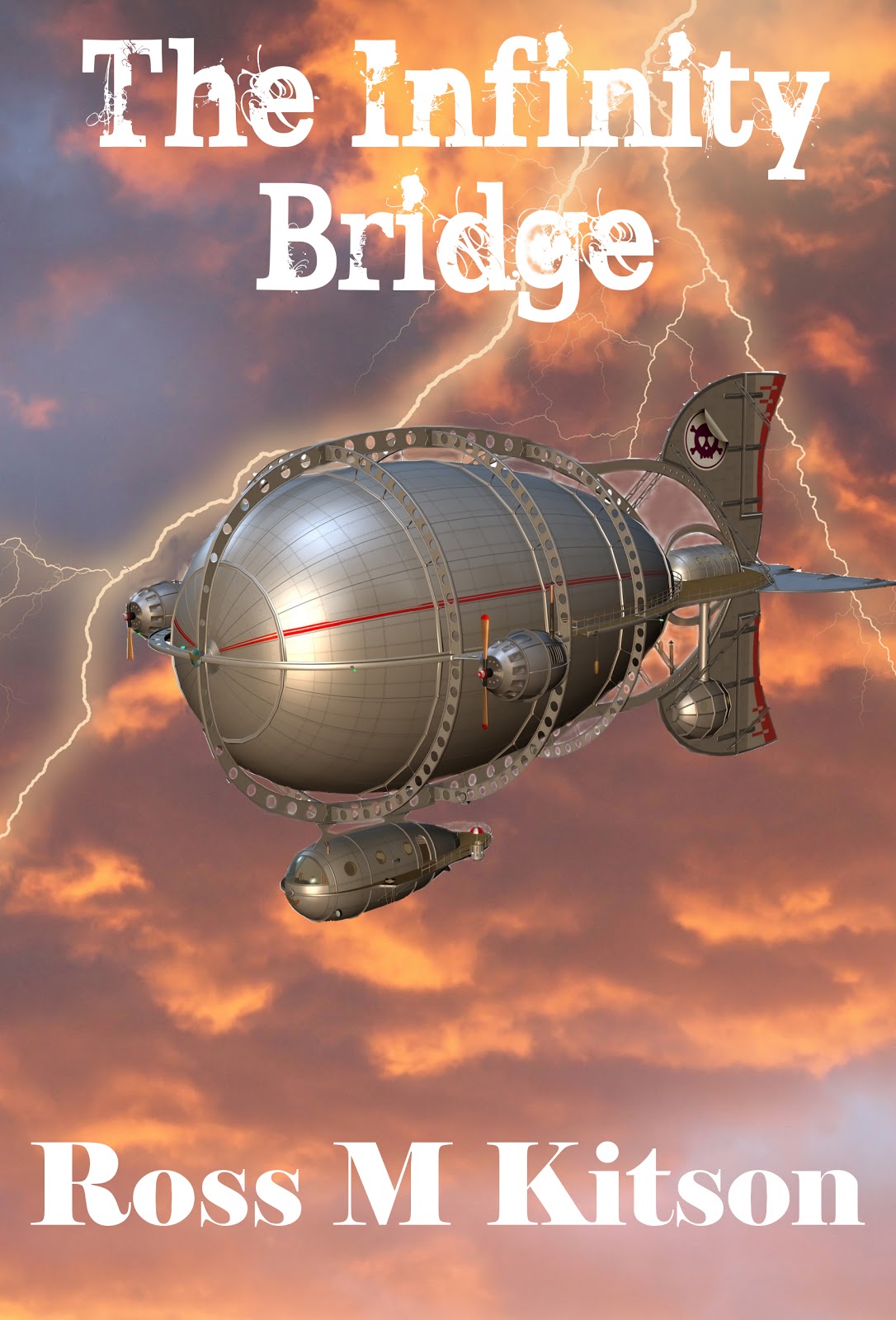
In fantasy, the line between the real and the unreal is intentionally blurred. The extent of the blurring may vary, but that line generally stays reliably outside the skull of the protagonists. The Infinity Bridge moves that line decidedly inwards. It strikes me that writing a believably insane character would be problematic for someone who is not themselves insane. We should be glad that Ross found writing those scenes difficult…

What it is about psychosis and dirigibles?

The opening text for the second chapter in my YA sci-fi / steampunk book Infinity Bridge reads:

Ever since he could remember Sam had seen monsters. That wasn’t quite true—he recalled the first time, so he must have been aware of the time before. His dad had just read him Not Now Bernard, a book about a boy who had found a monster in his garden.

Sam’s monster was actually shimmering behind the radiator, but the irony wasn’t lost on him.

He learned very quickly to keep quiet about it. If you told your parents about this sort of thing then they did one of two things: they either smiled then ruffled your hair or they made odd noises, like constipated hens.

Sam’s brother Ben had told them that he also saw monsters. He currently resided in a psychiatric hospital. That had pretty much made up Sam’s mind on the matter.

One of the core relationships in the book is that between Sam, the teen ‘hero’ of the book, and his older brother, Ben, who is being treated for schizophrenia. As we progress through the book we learn more about Ben and his subjective experience of  his psychiatric problems, and also start to wonder whether the fact he, like Sam, sees ‘rifts’ into other dimensions has created confusion with the diagnosis.

infinity bridge

I decided from an early stage that I wanted one of the key characters in the book to have schizophrenia, as I’d touched on other psychiatric illnesses in my epic fantasy series, Darkness Rising. It’s a condition that has fascinated me ever since I first treated patients with it during my brief stint in psychiatry. Yet being interested in it and writing about it in a believable, engaging and sympathetic way are two entirely separate things. How does one approach writing such a character?

The first is to try understand what the condition is and what it isn’t. I had some head start on this. There is a preconception, promoted mainly by crap films, that schizophrenia equates to (i) spilt personality, (ii) psychopathic serial killer or (iii) eccentric loner hobo characters. In reality it is a complex disorder, possibly caused by a mixture of neurobiological problems, genetic factors and environmental triggers, that may in fact represent a range of varying conditions. What it does involve is a break down in thought processes, altered perceptions, altered emotional responses and disordered beliefs. When I learned about it there was a division of symptoms into positive symptoms (hallucinations, delusions, thought disorder) and negative symptoms (depression, emotional flatness, self-neglect, poverty of speech).

Ben’s symptoms are predominantly positive—he has increasingly active auditory hallucinations through the book, such as one point where he has a dialogue with a Sat-nav (GPS to the American readers). He has delusions about intelligences within computer systems, which ironically turn out to be true in the book. There is escalating paranoia through the book as he comes off his meds, and he also has ‘ideas of reference.’ This is where he misinterprets meaning within things as having a direct reference to him as an individual.

‘Ben flopped his belly on the bar and had a quick look behind it. There was a serviceable stereo system connected to an amplifier there, as well as an army of glasses. He smiled as he saw a packet of cigarettes and a lighter tucked next to a bar towel.

He tugged them loose and pulled one out. A tingle of horror ran through him. There were exactly six in the packet. That couldn’t be a coincidence could it?

Ben’s eyes darted to the far end of the bar. Sure enough, there were six beer mats on the end of the bar. He took a deep breath and looked at the optics above the bar. There were eight dusty bottles of spirits.

He stumbled back from the bar. His hand reached for the handgun tucked in his jean’s waist band. Six-six-eight. It was an omen, he was certain: a warning that danger was nearby.

Ben held the gun in his shaking hand then moved cautiously across the dance floor. Whispers were drifting like pollen on the breeze, tickling his ears, pinching his brain. Ignore them, Ben, he thought. They are working against you—making you more paranoid.

A poster was half peeled from the wall by the door to the stairs. It promised two drinks for three quid each Monday before ten’o’clock. Ben counted the words and then swapped the letters around in his head. It was a code. It really said—‘Just because you’re paranoid, doesn’t mean someone isn’t really out to get you.’

He ran. His boots pounded on the stairs in time to his racing heart as he hurtled to the first floor. The large room was cluttered with furniture, mostly covered in white cloths. Like shrouds hiding corpses.

The whispers were getting louder.

Ben retains insight into his psychosis throughout the book, which makes his deteriorating condition more manageable. Often he will have an internal monologue going, an argument between himself and another voice, often Sam, and this allows him to rein in his impulses and compulsions when the pair enter a Steampunk alternate.

One challenging part of the character was to write decent dialogue. Some individuals with schizophrenia display distinct speech patterns, which in severe cases become an unintelligible ‘word salad.’ If you have ever seen the (excellent) film A Beautiful Mind you can hear how Russell Crowe’s speech deteriorates in the latter parts of the movie. There are features of rhyming words (e.g. Sam, spam), neologisms (I.e. fabricated words), substitutions (e.g. Nick, to ‘shaving cut’), repetition and changes in context, which may display their underlying thought disorder. The ‘derailment’ of the theme of a dialogue, with very loose associations between topics, can make it tricky to follow what is meant.

I tried to create a balance which displayed Ben’s underlying mental state, illustrated his meaning and thoughts, and also showed his warm humorous character. At times it involved a lot of rewriting to adjust the balance, not least because there has to be some ability for the reader to comprehend what he means within his dialogue.

Ultimately what I wanted to create in Ben as a character was a likeable older brother who, on a background of mental health problems, is thrown into a bizarre world of clockwork androids, intelligent computer viruses and alternate worlds. In doing that Ben displays courage and reserve that drag Sam through some of his own demons and insecurity, and indeed guilt, to come through for his friends at the story’s finale. In future books there is a lot more planned for Ben, and as difficult as it is to write him I look forward to every moment of it.

Buy Book: kindle us | kindle uk | dead tree | smashwords

Visit the author’s website | book website | follow him on twitter | facebookgoodreads |

Democracy in action

You, the voters, have made your wishes known.

Fully 100% of you indicated that you would prefer to have all of the final installment at once, in a big steaming pile nine days from now. While there might be some readers out there who would prefer their Veil War in smaller, manageable doses – it doesn’t look as if they’d outnumber the gluttons in any reasonable voting model.

So mote it be.

Question for you, the dear reader

Here’s something for you to consider. I’ve just been editing the final chapter – #36 for those of you keeping track at home – and realized that it’s coming in at nearly 4000 words. Over the course of this whole thing, I’ve aimed at 2000 word chapters, and usually failed. Most are in the 2200-2700 range. A couple broke 3000. But 4000 is pretty big. There were a few things I needed to take care of…

So, I put it to you. Do you want the whole big thing next week, or should I break it up into two chapters and post them separately?

Make your opinions known in the comments and I’ll do whatever the majority chooses, almost as if this were a democracy or something.

Antepenultimate Chapter

It is, once again, that most treasured time of the year: Veil War Thursday. Chapter 34 is now come into the world, and is awaiting your attention.

“No!” he screamed. He ran toward the fire, icon tucked under his left arm like a football and axe in his right. Like the bow wave of a speedboat, the icon pushed the serpents back as he charged. He slowed; he was running through molasses. The resistance of the mystical barrier or the palpable evil of the serpents fire pushing him back. Kimball dug in, felt pain in his legs and arms as he pushed through. Agony arced down every nerve, and he screamed again, wordlessly.

He fell to the ground when the wall collapsed. The icon flared golden-white and the serpents were blown to wisps of fog, and dispersed. Another goblin summoner dropped, gripping his head in both hands and crying out in agony.

Remember your duty to catch my mistakes and trumpet them in the comments!

The Really Big Idea: Paul Ducard

Theodicy is a real problem for literature. A real problem for anyone, sure, but the problem of the origins and nature of evil is a thing that most authors assiduously avoid confronting. When even the greatest writers try to hit it head on, the results are often… interesting. Outside the Old and New Testaments, the two most powerful and influential Christian works are the Divine Comedy and Paradise Lost. Milton was a believer, a puritan, yet when he set pen to paper to craft his poem, Satan ends up the hero. We can understand, and sympathize with, Satan’s cry of Non Servium! Lucifer has a human face – we recognize him. How can something we recognize be entirely evil? Flawed, perhaps…

God himself is ineffable, impossible to relate in fiction. Gregory Palamas said that we can’t know Gods’ essence, but we can know his energies, his effect on the world. Perhaps true evil is something else altogether as well – something more Lovecraftian. We can see the effects of true evil, but not know it without losing our sanity.

War in Heaven: The Other Side of Evil

“Are you religious?” It’s the inevitable question I’m asked whenever I explain the concept and theme of The Other Side of Evil to an interested potential reader.  My most common response, “No.  I was baptized Catholic but I’ve been to more Shinto shrines and Jewish Synagogues than Catholic Churches,” often leads to quizzical looks.  “Then what made you write the book?”  It’s not an easy question to answer.

Truth be told, I don’t adhere to any organized religion.  It was my interest in the development and history of religion that drove me to explore the foundations of the many faiths that proliferate, not the spirituality supposed ingrained in belief.  What I consider to be logical questions motivated me:  How do these religions have such a hold on so many people? Where did their rituals develop and what social and economic conditions influenced their core belief systems?  What was considered apostasy and why?  Who got to decide what was important and upon what basis were these decisions made?  What motivated people to release themselves totally to something that can’t be touched, tasted, or seen in a literal way?  It was the history of religion that drove me to classes on John Milton in university.

Paul Ducard cover

Sitting one day while discussing Paradise Lost, it struck me as odd when the professor introduced the idea of Satan as the “hero” of that most famous of modern epic poems.  It’s Milton 101, yes, but I was still an impressionable 19 year old and the concept was new to me.  I mean one simply does not naturally associate Lucifer/Satan/the Devil as the “hero” of anything other than evil.  But if one regards the “hero” as the main protagonist of a story, the character for whom the reading audience develops the strongest connection, the deepest sympathies, then Milton’s Satan takes the cake.  He’s the classic underdog so many people like to root for, leading the “free armies” of heaven to make things right.  His only real evil is that he does not obey God and for that he burns.  Literally, it turns out.

Identifying with this controversial take on the supposed author of all evil, I considered whether the stories we know of Satan were the stories of a crooning victor; God’s version of what happened, as biased as one would expect it to be. What conquering society hasn’t changed written history at least a little bit in order to persuade posterity that their cause was the right cause, carried out in the right way?  So far as I know, no ancient, medieval, or modern society has proven itself completely immune to this little creative indelicacy.

That got me thinking.  What if I had the chance to sit down with John Milton’s hero and understand the story of his fall from God’s grace…from the his point of view?  The loser’s point of view?  What would Satan tell me?  Would he lie, as all students of western religion are taught to expect?  Would he take the opportunity to give his jump-up-and-down-on-the-sofa, shouting out to the airwaves, “tell it all” story?  And if he did, and it turns out his claim is that God rewrote history to cover up what would otherwise be the proverbial chink in the armor of faith, what would Satan tell us about the lies God had to tell in order to justify the slaughter of so many of His angels and the insubordination of his most revered creation?  Even more, what would happen if Man came to know of God’s half-truths, fabrications perhaps?  Would Man’s faith, so elemental to accepting God as the divine light that so many religions claim him to be, falter when it became known that Man’s creator was, indeed, as malignant, deceptive, and self centered as so many of history’s victors?  “The story of Satan has to be told,” I thought.  My paper on the evolution of Satan as portrayed through literature got me an “A” in the class but, more importantly, it set me up to begin crafting the tale that would become The Other Side of Evil.

I harnessed my love and knowledge of ancient and military history to create a truly new storyline but with many of the same characters and places we’ve become accustomed to and comfortable with.  The Heaven and Hell of The Other Side of Evil had to be something no one had ever read before, yet it had to be plausible.  To that, Heaven had to be like any empire that’s existed through time.  Roman.  Vicious and singularly focused on making itself the most important power in the known world.  Byzantine in the huge bureaucracy needed to keep the known universe afloat, with the inevitable backstabbing and power brokering that accompanies so many people jockeying to get ahead.  Olympian in the sense that violent revolution brought the Supreme Being to power and his subjects were slaves to his ephemeral whims.  When, years later, I finally got down to putting words to paper, it wasn’t too difficult to dip into my many experiences working as a lawyer for international broker/dealers, banks, and government regulators, and develop the vile and vituperative world that had to make up the Heaven and Hell, in all their glory, of The Other Side of Evil.

As it turned out, the smoke-and-mirrors world of government and the faith-based world of religion were two sides of the same coin.  I mean, let’s face it.  What could the war of all wars, the war in Heaven, have been if not political?  And if it all came down to politics, why should any of us have the faith demanded by the great religions of the world necessary to achieve salvation?

In the end, The Other Side of Evil is fiction.  It tells a story.  It’s not meant to espouse atheism directly but it is meant to give a reader another angle from which to look at something that has often been taken for granted.  And if that reader comes away from my story and asks themselves some deeper questions than perhaps they’d asked themselves before, I’ve done the job I set out to do those many years ago, in that classroom, reading of Man’s first disobedience and the supposed cause of it.

Buy Book: amazon | amazon author page

Visit the author’s website | follow him on twitter | facebook | facebook book page | google+

Achievement Unlocked


Typed, “The End” today.

And now for something completely different

Actually, just kidding. It’s Thursday, and that means Veil War. Chapter 33 is up, so read and enjoy.

Van Buskirk staggered back to his feet. He checked behind, the flag still flew. The men still held the line. Two crusader knights leapt over the heads of his soldiers to land right in the midst of the advancing goblins. Five seconds of pirouetting death dealing and they leapt back to the comparative safety of van Buskirk’s line, leaving dozens of goblins dead and momentarily slowing the assault. Momentarily.

Ever and as always, use the comments to demonstrate your superior knowledge of spelling, grammar and usage. Thanks for reading!

Oops

The previous post, the Grand Re-Opening of the Really Big Idea Series, went out in the wrong version. If you read it before around 8:00, please note that it now has an actual introduction and not the enticing, blunt yet but still accurate single word, “Intro.”

The Really Big Idea: Ross Willard

After a long absence, the Really Big Idea returns with Ross Willard, who found an interesting way to get around perfection.

If you were perfect, would you find your life interesting? Enjoyable perhaps. But there might not be many stories to tell the grandkids if every decision you made was correct and wise; if every path you took was lined with roses and adulation. But maybe the frustration of those who have to deal with you would be worthy of a story or two…

System Purge

When I was a younger writer, one of the problems I often found in my writing was that my protagonists tended to be “Too Perfect.”  Perhaps it was all that time I spent reading comic books, or perhaps I was creating the characters to comfort myself and couldn’t stand for my heroes to be flawed, but somehow all of my characters ended up being so good at absolutely everything that nothing was ever a challenge for them.  Not really, anyhow.

System Purge

Since then I’ve learned the joys of writing flawed characters, but in order to get from there to here took a certain amount of self-training, and the first step, for me, was writing second generation characters.

Essentially, I knew that if I created a whole new universe to work in, I would simply create a whole new set of overly perfect characters, in order to make myself start imagining characters who had to struggle and grow, I had to stay in the same universe I’d worked in before.  The logic went something like this: if I had a character who was a perfect fighter, and I wrote a story about, say, one of his students, then I clearly could not make that student as skilled as his teacher, thus I could make his life a perpetual struggle.

That’s correct, in order to write an interesting story, I had to trick myself into making an interesting character.  While I have long since abandoned most of the universes that I had to use this trick in, there was one world that struck me as interesting enough to bear revisiting when, after several years of practice as a writer, I stumbled upon some of my old writing.

The too-perfect characters I had created were a brilliant scientist and the sentient machine he’d created.  Both characters were far too intelligent and far too powerful to be interesting, but the effect that they had on the world was, potentially, fascinating.

It wasn’t just the introduction of self-aware robots and genetic engineering that captured my imagination, it was the legacy that the characters had left behind.  Specifically, I couldn’t help but wonder what their creations thought of the two.  After some thought, I realized that the man and the machine would be seen either as father figures, or as gods, which of course led to the even more interesting question: what does a society do when their gods abandon them?

In building the universe, and the backstory of these two absent characters, I realized that there were three groups with relevant perspectives: there were the machines, who had known their creator and progenitor personally, there were the genetically engineered humans, who knew of him, but only distantly, and there were those who lived in the ‘human’ world (ie contemporary society) who had been effected by both characters, but did not know anything about them.

My book has three main characters in it, each with a slightly different relationship to their ‘father.’  While it isn’t expressed outright, a lot of the subtext that I tried to put in it is about each of these characters coming of age.  Each one needs to ‘grow up’ in a very specific, and very different way, and each one is dealing with an very different ‘absence’ in their life.

Buy Book: amazon

Visit the author’s website